
Water Out of Thin Air, Skywalker-Style (Part 2)
Part 1 made the case that dry-cooled, solar-powered desert data centers need only a trickle of water to cool because today’s AI processors are able to run with less cooling. Water harvested from the desert sky can plausibly supply this minimal amount. Part 2 covers the Nobel Prize behind the technology, the companies shipping today, and the real costs.
By: Jason Bak
The Nobel Prize: What It Buys and What It Needs
The 2025 Nobel Prize in Chemistry went to Susumu Kitagawa of Kyoto University, Richard Robson of the University of Melbourne, and Omar Yaghi of UC Berkeley “for the development of metal-organic frameworks.” Metal Organic Frameworks (“MOFs”) are crystalline lattices of metal nodes joined by organic linkers, riddled with pores so vast that, as Yaghi likes to say, a single gram can contain the surface area of a football field.
MOFs use the same capture-and-release cycle as silica gel and zeolites, but with vastly more internal surface area. Crucially, their pores can be tuned deliberately, almost atom by atom. That tuning lets chemists place the “switch point” wherever they want so that the material starts grabbing water once humidity crosses a set point.
Chemists have now built 137,000+ different MOFs (per the Cambridge Structural Database) and have used them to capture carbon dioxide, store hydrogen, and separate PFAS (the “forever chemicals” found in contaminated water), all in addition to grabbing water.
MOF-303, as used by Yaghi’s Death Valley device, is the star. It’s built so that it grabs water even in bone-dry air (its uptake turns on sharply around 12% humidity) and then releases it again around 113°F (also doable with a bit of solar energy to assist).
Now the catch. “Regenerating” a sorbent means driving the captured water back out of it, so the material is dry enough to adsorb again on the next cycle: Heat goes in, water comes out. Heat only flows from hotter to cooler, and it flows quickly only when the gap is large. In Death Valley, the solar panels on the MOF-303 device pushed its chamber to 149°F, comfortably above the material’s 113°F release threshold.
In data centers, a liquid-cooled server hall sends its coolant back at about 105–130°F, a band that brackets MOF-303’s 113°F release point rather than clearing it. A gap that narrow is like trying to warm a room with a radiator barely above room temperature. So server waste heat on its own can’t finish the job. What it can do is pre-heat the sorbent’s regeneration airstream most of the way there, so the hotter source that completes the release has less work to do. This hotter source for the final lift could include solar thermal or the exhaust of an on-site fuel cell.
The science of the newest MOFs is genuinely novel, and the prize is deserved. But a Nobel Prize is a recognition of discovery, not a scalable product. The distance between a Berkeley lab bench, a Death Valley demonstration, and a machine that reliably supplies a data center for twenty years at scale is measured not in insight but in capital equipment, service networks, and years of field data. That gap is where the money is now piling up, and where the story gets interesting.
Atoco: The Prize-Winner’s Path to Commercialization
The company carrying the Nobel halo is Atoco, the Irvine, California startup that has licensed Yaghi’s MOF technology, with Yaghi as its founder and chief science officer and Samer Taha as CEO. In a Bloomberg feature published in May 2026, Atoco unveiled a grid-powered, shipping-container-sized prototype that the company says can produce up to 1,000 gallons of water per day and operate below 20 percent humidity. It’s explicitly targeting data centers “as the artificial intelligence boom stresses water supplies across the US.”
Then come the caveats, and they are substantial. By Atoco’s own account, it “isn’t taking orders yet.” It expects to begin doing so in the second half of this year, and plans to manufacture about 200 harvesters in 2027. The company says it has been testing the machine with partners around the world, but, like many pilot-stage companies, has not yet released results to the public. Atoco is backed by a private-equity firm, Revonence Technologies, which declined to disclose amounts in an interview with the Orange County Business Journal, and the company declined to comment on its fundraising to Bloomberg. A ~$1 billion valuation circulates in sector chatter, but it appears in no press report or tracker.
The arithmetic is worth doing transparently: In Death Valley, MOF-303 delivered about 0.2 kilograms of water per kilogram of sorbent per cycle. To produce 4,000 liters (4,000 kilograms) of water per day at one cycle per day would require 20,000 kilograms of MOF. This equates to twenty metric tons of Nobel-winning crystalline MOF. Under optimistic assumptions about running several fast cycles per day, that might fall to around 6,000 kilograms. Published techno-economic analyses of closely related aluminum and benchmark MOFs put production costs in the range of roughly $30 to $70 per kilogram at industrial scale. Even taking that as a proxy, the sorbent alone in a single large unit could run somewhere between roughly $180,000 and $1.4 million, not including the condenser, blowers, controls, enclosure, and installation.
Durability is the other open question. Lab tests show MOF-303 retaining about 96 percent of capacity over 50 adsorption cycles, however a commercial machine cycling daily for years faces thousands of swings. Add desert dust, sandstorm fouling, binder and pelletization losses (the Berkeley team used a graphite binder that preserved about 85 percent of surface area), and the engineering of regeneration heat integration. None of this is disproved, but 50 cycles is a long way from the 5,000 to 15,000 cycles a unit would rack up over 15 years, and without the benefit of weather and sand protection.
The instructive contrast is Yaghi’s other company. Water Harvesting Inc. (WaHa), founded in 2018 and also built on his chemistry, took seven years to reach its first commercially available unit, unveiled at the WETEX exhibition in Dubai in late September 2025. It raised about $8 million in a Series A-1 in July 2025. In June 2026 it named a distributor, Ibyma, to sell on-site AWG into Permian Basin workforce camps in West Texas and New Mexico, the very geography the AI boom is colonizing.
Yaghi is the scientific founder in both ventures. WaHa spun out of his Berkeley lab in 2018 and runs with its own management, while at Atoco he serves as founder and chief scientist and CEO Samer Taha runs the business. The common thread is the chemistry.
However just a few weeks ago, Yaghi stunned the industry by adding a third horse: He departed for China’s Tsinghua University to serve as a full-time Chair Professor in the university’s Department of Chemistry. In this capacity, he will lead a new institute in AI materials research. He had served as an honorary professor at Tsinghua’s Institute of Nuclear and New Energy Technology since 2022. The Chinese Communist Party’s (CCP’s) Qiu Yong, Secretary of the CPC Tsinghua University Committee, presided over the appointment ceremony. Atoco, for its part, says Yaghi will remain “more involved with the company than ever before” and still plans to meet its 2027 targets.
So Who’s Actually Doing It?
As of late August 2026, no operating US data center draws its water from AWG. The closest thing is AirJoule, a NASDAQ-listed firm whose core technology sits in a joint venture with GE Vernova, and whose waste-heat-powered “AirJoule Prime” unit (rated up to 2,000 liters per day) was commissioned in Newark, Delaware in May 2026. The product was selected as one of three winners of the Net Zero Innovation Hub for Data Centers competition, announced September 25, 2025, from more than seventy applicants. The nearest US step is in Hubbard, Texas, where AirJoule runs a field demonstration unit in collaboration with the city and Nexus Data Centers, ahead of a planned water purchase agreement at the Nexus AI campus under construction there, targeted for the second half of this year (per the companies).
A data-center testbed collaboration in Denmark was announced on August 18, 2026, with an AirJoule Prime unit slated for deployment at a member site. The first arid-climate numbers will come from a separate Arizona State University testbed in Phoenix, with results still pending.
Companies actively delivering products at scale include a few standouts:
Genesis Systems: Live in Medical, Residential and Military Applications
Founded in 2017 in Tampa by David and Shannon Stuckenberg, Genesis Systems® (USA) - Water Your Way has built the industry’s most decorated product line and the strongest defense and government relationships. The company’s WaterCube line is numbered by output: 10 gallons per day from the portable WC-10, 100 from the residential WC-100, and 1,000 from the utility-scale WC-1000, with patents covering operation at each of these scales.
Genesis Systems’ fourth-generation technology works by using a lithium-chloride-class brine as a liquid desiccant to sponge moisture from a large ambient airflow. The brine then hands that moisture to a much smaller internal air stream, which deliberately pushes that stream’s humidity above ambient, and the small, artificially humid stream is condensed, thereby moving the hard work from the compressor to the brine. It’s the difference between cooling a stadium to wring out a glass of water and cooling a phone booth. On paper, this vapor-consolidation stage extends the usable range well below where a bare condenser gives up, because the internal stream can be pushed toward saturation regardless of how dry the desert outside is.
When Hurricane Milton knocked out water mains in St. Petersburg, Florida in October 2024, a WaterCube 1000 deployed by the State of Florida supplied backup water to Johns Hopkins All Children’s Hospital, which Genesis says averted an estimated $10 million in service disruption (https://www.wired.com/story/milton-disrupted-the-flow-of-drinking-water-so-florida-deployed-a-machine-to-harvest-it-from-air/).
The containerized unit deployed at Johns Hopkins Hospital is press-listed at $860,000. In high-desert air, our modeling puts the same machine’s output on the order of 100,000 gallons per year.
Time Inc. named the US-made WC-10 and WC-1000 WaterCube units in its Best Inventions of 2025 list. The WC-100 was a CES 2024 Innovation honoree.
On the defense side, Genesis received an AFRL/AFWERX Phase II award of about $1.2 million in March 2024, a $1.25 million CBRN-hardening award in August 2024, a $2.0 million US Air Force Tactical Funding Increase through AFWERX and AFRL in September 2025, a Cooperative Research and Development Agreement with the US Army Engineer Research and Development Center in November 2025, and a $10.5 million US Department of Defense procurement line opened in May 2026 to purchase WaterCube units. The company had announced in March 2026 that its military-grade units passed the US Army’s TB MED 577 water-quality standard. This month, the company was awarded a $49,898,000 firm-fixed-price IDIQ from the DoD (contract W911QX-26-D-A004) after WaterCube units sustained operations through a live attack during Operation Epic Fury in the Middle East.
The caveats are equally real, and mostly come from Genesis’s own materials. The company states ideal conditions of 80°F and 60 percent humidity; a TechHive review noted the machine “works best when humidity is 35 percent or higher” and drew about 1 kWh per gallon. The company says it has modeled 10–20% of rated capacity in sub-20% relative humidity. The company claims that installations with a major oil company have demonstrated energy use as low as 0.5 kWh per gallon. If confirmed, it would be roughly twice as efficient as anything independently measured. At that efficiency, with surplus solar making the marginal power effectively free, Genesis estimates operating cost below $0.01 per gallon.
Watergen: 90 Countries, High-Volume for Seaside Humidity
Watergen Ltd, the Israeli pioneer founded in 2009, is the incumbent. Its condensation-based units include the household GENNY at 25–30 liters per day, the GEN-M at 800, and the industrial GEN-L at up to 6,000 liters (about 1,585 gallons) per day. The company reports deployments in over 90 countries. In August 2020, a GEN-L was installed at the Nasser Medical Center in Khan Younis, Gaza, producing 5,000 liters of drinking water per day where the hospital had been trucking water in. Watergen is candid about its lane: It builds for humid climates and does not claim to conjure water cheaply from desert air. Within that lane its company-reported energy figures, roughly 0.25 to 0.35 kWh per liter per its spec sheets, are genuinely competitive.
Aquaria, Another Seaside Solution
Aquaria was founded in 2021 by brothers Brian and Eric Sheng. The company won a TIME Best Invention of 2024 for its Hydropack “Hydrogrids”, which consist of multiple modular AWG units ganged together and scaled in parallel like a solar farm to serve an entire community. They raised $112 million in November 2024 as reported at the time, of which $100 million was a project-finance facility from Upwell Water to supply a 1,000-home community development in Hawaii.
The Hydrogrid’s advertised outputs are rated at 86°F and 80 percent humidity per Aquaria’s spec sheet, warmer and wetter than the industry’s usual test point. Notably, in a field prone to overpromising, Aquaria is candid about its units dropping off sharply below roughly 30 percent humidity and, like many if not most products, requiring a storage tank to bridge dry spells.
Others
Spain’s GENAQ, part of the KEYTER refrigeration group, has been developing atmospheric water generators in Lucena, Córdoba since 2008. Its condensation lines run from the 5 gallons per day Stratus dispenser through the Nimbus and Cumulus ranges to a custom AWG plant tier that the company rates up to 400,000 gallons per day. Generation curves are certified by TÜV Rheinland under stated temperature and humidity conditions. The company reports a footprint at anywhere from 44 to 70+ countries. Spanish trade coverage pegs its annual revenue near €1.1 million, so the footprint measures reach, not scale. India’s Airowater Designer , founded in 2020 and GreenPro-certified by the Indian Green Building Council, builds condensation units for a largely domestic market. Florida’s Altitude Water, formerly the Trident Water Company, ships its Trident line up to about 360 gallons per day into US, Caribbean and Latin American disaster-relief service, and states best performance at 40% relative humidity or above. Sweden’s Drupps (on the industrial liquid-desiccant side), sorbent-stage Uravu, and countertop consumer plays like Kara Water round out the field.
A breakdown is in the table below.
SOURCE Global: The Cautionary Corpse
For years, a poster child of atmospheric water was SOURCE Global, the Arizona company (originally Zero Mass Water) that made solar-powered “Hydropanels.” Founder Cody Friesen told CNBC the panels could produce “perfect drinking water essentially anywhere on the planet.” The company raised $270 million from an A-list of backers including Bill Gates’s Breakthrough Energy, Microsoft’s Climate Innovation Fund, BlackRock and Duke Energy Corporation. It ultimately installed panels in more than 50 countries, including some 500 homes on the Navajo Nation.
The reality was thinner. Independent measurements put a Hydropanel’s output at roughly 2 to 5 liters per day at a cost around $0.20 per liter, which was orders of magnitude above tap water. The company’s warranty commitment quietly shrank from an advertised 20 years toward far shorter terms, with field failures reported within 2-3 years and quality problems traced to overseas manufacturing. An April 2025 SEC filing showed SOURCE seeking $75 million and having placed just $19.3 million of it. Friesen announced his departure shortly thereafter.
The company that was supposed to prove atmospheric water at scale is now effectively defunct. The vaporware graveyard behind it is crowded: WaterSeer, Fontus, and the Skysource/Skywater XPRIZE winner all generated headlines, but little lasting hardware.
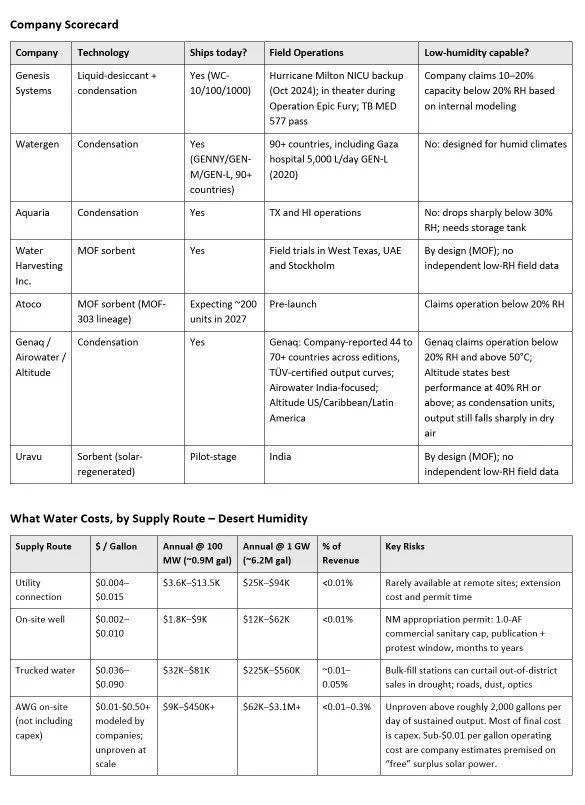
Company Scorecard & Water Costs, by Channel (Desert Humidity)
The punchline: even the most expensive water sources run well under 1% of revenue at either scale. That expense is immaterial next to the losses if a facility must halt operations, as a conventional evaporative system would when its water fails.
Water can also matter on some of the hottest days if a less-overbuilt waterless cooling system’s radiator field is leaning on backup spray water. In that design, the spray reservoir becomes critical infrastructure.
A single such outage costs more than a year of trucked water at either scale. At typical AI lease rates an hour offline puts roughly $27,000 of revenue at risk at 100 MW and $270,000 at 1 GW, before idle-GPU losses and penalties that can multiply those figures several times over. The Uptime Institute’s 2026 analysis finds one in five major outages now tops $1 million.
Better yet, on operating cost alone (energy and filters, capital excluded, as the table shows), AWG already undercuts trucking in temperate climates, and desert operating costs are poised to follow where the AWG is powered by solar. On desert bright days, an east-west solar field produces more energy than the batteries can absorb, which makes the power needed for the AWG units effectively free.
Summary: The Desert Revisited
Put the pieces together and a workable, potentially water-positive design emerges:
Water positive means producing more water than the facility needs to operate. Waterless cooling for the AI compute is the clearest path there now that AI processors don’t need as much cooling. Truck in water and install AWG units, each serving as backup for the other. Use most of the water for the employee breakrooms, with the surplus used for emergency splashes on the radiator on unusually hot days. Run the water harvesters overnight on banked surplus solar power when the air is damp and the marginal power is effectively free. Harvest hardest during the monsoon. Bank the surplus water in closed tanks to carry through the dry months. Recycle treated restroom water to further fill that reservoir.
Then provide surplus water, as measured production allows, for additional non-potable uses in the community.
The result: No strain on the local water utilities or aquifers, all with less capex on the radiator-field overbuild, which is almost certainly a much greater cost than the AWG units.
As lifelong renewables developers, we think combinations like this stand to fulfill the long-standing promise of genuinely power- and water-neutral, or even water-positive, AI compute at utility scale.
Jason Bak and his Green Data team have developed over $23B of renewable energy and data center facilities for global power utilities and virtually every hyperscaler. The company is currently developing solar-powered compute infrastructure in Texas and New Mexico.
Sources available upon request
#DataCenters #AIInfrastructure #AtmosphericWaterGeneration #AWG #WaterTech #NewMexico
