
post 5: compute only matters if the data can connect to the center
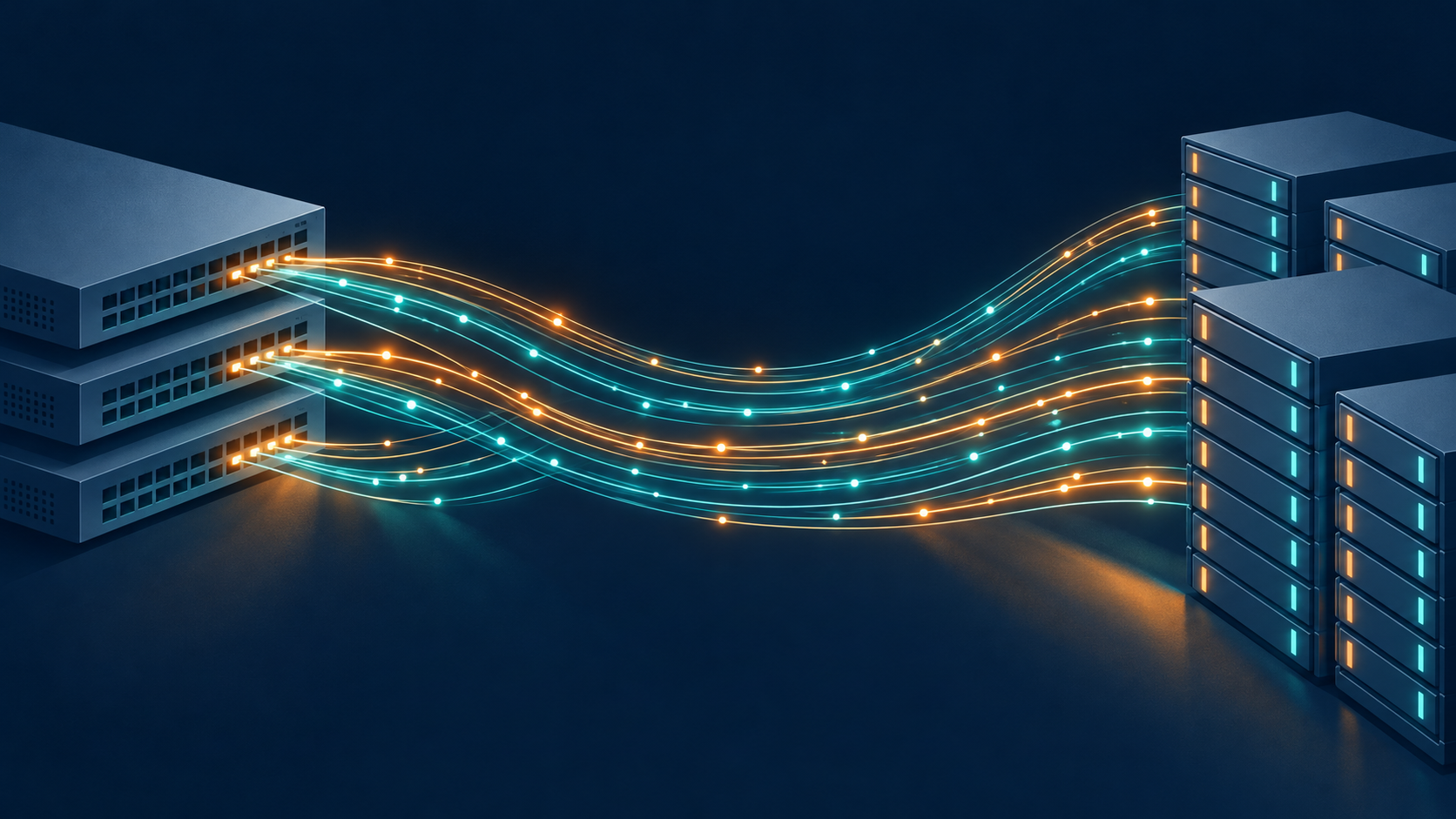
One detail in Data Center Frontier's Data Center World reporting caught my attention: suppliers were discussing fiber installation labor and completing more work before the equipment reached the site. That is a useful reminder of what sits underneath an AI networking presentation. Somebody has to connect the system.
My frame for this post is the waiting processor problem. I want to follow the data from storage, through the network and into the computing system. Permission to compute means little if the work arrives late. So when looking at the systems and technologies that connect the individual parts of the data center together, any data center operator needs a holistic view as to how all the parties work together.
There is more than one network
The first distinction is between tightly connected computing and the wider cluster. NVIDIA places NVLink in its scale up layer, with Quantum InfiniBand and Spectrum Ethernet platforms addressing scale out communication. I will look at each of these separately when comparing outcomes.
That distinction extends across the data center facility. NVIDIA also describes networking across buildings and sites, alongside BlueField DPUs that perform infrastructure functions. The word network covers several design decisions, not a single switch order.
Operators should understand the traffic paths within and outside of their facility before selecting equipment. Which traffic connects accelerators? Which brings data from storage? Which handles users and administration? Operators should want to know what shares a path and what has its own.
Speed is only one part of delivery
The supplier roles differ. Arista supplies complete switching platforms and EOS software, while Broadcom supplies networking adapters and associated silicon in their joint AI networking brief. Those are related but distinct procurement layers.
The same brief lists 400G and 800G Ethernet systems and describes RoCEv2, Remote Direct Memory Access over Converged Ethernet, together with congestion controls and load balancing supported by Arista and Broadcom. I would read and understand the congestion section before being impressed by the port speed.
There is a reason to look beyond a quiet network test. Arista's brief describes mechanisms that detect congestion, pause selected traffic classes and adjust routes or load distribution. I would want to see the workload when several systems need the same resources at once.
As an operator, my questions would be straightforward. What happens during a traffic burst? Which measurements show where the delay begins? How is a degraded link identified? A network comparison should give the operator something more useful than the sum of its ports.
The optical layer has its own suppliers
Cabling and optical components belong in the system architecture. Corning describes fiber connectivity components supporting optical interconnects close to networking silicon. I would include installation and replacement access in that discussion.
There are Israeli suppliers on both sides of the connection. Xsight Labs, headquartered in Kiryat Gat, develops switch silicon and DPUs for AI and large data center networks. Its role is at the semiconductor layer.
DustPhotonics supplies silicon photonic integrated circuits used in optical transceivers, including products for retimed and linear optics arrangements. That is a component comparison within the optical system, rather than a replacement for an entire network installation.
There are three evaluations here: the chip, the complete network product and the installed cabling system. Which specifications must match? Who qualifies the combination? I would want that responsibility assigned before the equipment reaches the rack.
Storage has to join the conversation
The workload needs more than communication between processors. Micron describes SSDs holding datasets, models and outputs, with memory serving active work close to processors. Storage capacity and the processor's immediate working memory solve different problems.
At the system level, Dell offers PowerScale for AI data workflows, while WEKA describes distributing data, metadata and I/O across its NeuralMesh cluster. I would compare them against the actual data access pattern and pathways that are utilized (not just theoretical) by customers
The Israeli connection is already inside that supplier base. WEKA and VAST Data both list Tel Aviv offices. They are global suppliers with not local alternatives in a separate market.
The architectures also deserve individual treatment. VAST Data describes a platform spanning storage, database and data access services, with file and object interfaces and a shared global namespace. I would ask which parts the customer needs before evaluating the entire platform.
For training, WEKA explicitly includes checkpointing among the changing I/O demands its platform addresses. I would test saving and recovering work as well as feeding data into the processors.
There is another dimension to that test. WEKA distinguishes scaling metadata capability from simply expanding storage, alongside the need to distribute I/O across the cluster. I would ask for a demonstration with the customer's data layout and job mix. A capacity figure alone would not settle the question for me.
Our view
When building a data center and reviewing the specific equipment suppliers, I would ask every network and storage proposal to answer the same operating question: where does the workload wait? The answer should identify a measurable constraint, not simply point to a faster generation of hardware.
For investors, I would then ask who owns the remedy. It might be a specialized chip, a complete system or software that changes how existing equipment is used. That is a better starting point for understanding value than placing every supplier under “AI connectivity.”
Final Thoughts
The waiting processor problem connects networking, optics and storage without making them the same business. I would follow the data path, test it under pressure and ask who supports each connection. Useful computing is the result we are trying to buy.
