
Electricity before intelligence
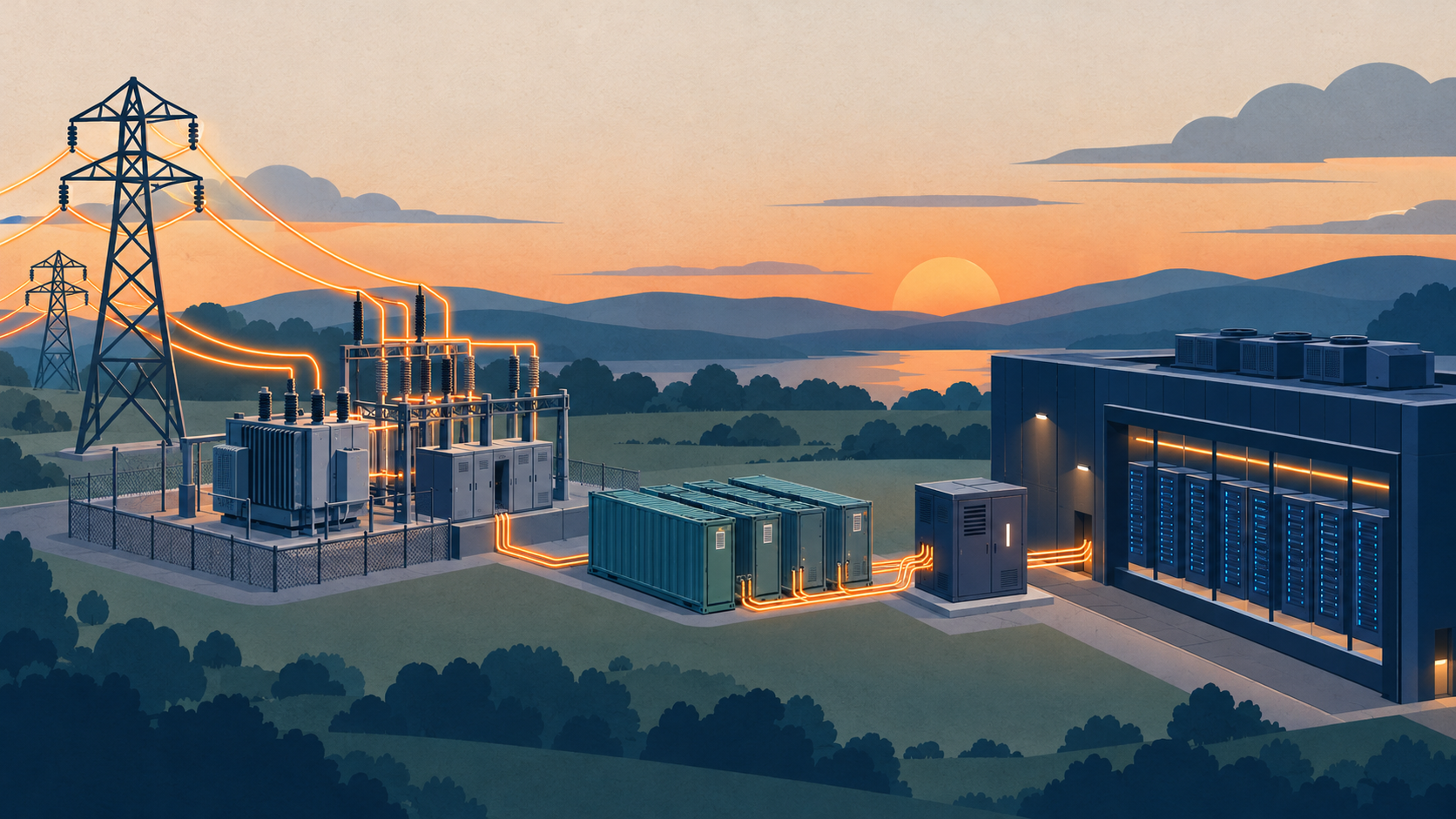
Reading Data Center Frontier's account of Schneider Electric's discussions at GTC 2026, I was struck by the change in emphasis: the engineering challenge was as much about getting electricity into the rack as getting heat out. That is a useful place to continue this series. A connection to the grid is the beginning of the power discussion.
In my first post, I called the supporting infrastructure permission to compute. In this post, I want to make that more specific: the usable megawatt. I mean electrical capacity that can reach the computing equipment reliably, under the conditions the operator actually expects.
Electricity usage at a datacenter is just like in your home, there are low, regular and peak usage periods. As more compute is routed by a client to a specific center, the GPUs and CPUs need more energy to run. So understanding the electrical infrastructure of any specific location will provide the investor a “tell” as to the volume that an operator is prepared to manage. And since datacenter operators get paid per giga-watt hour, the more compute requests they can handle, the more money they can make. And a number on a site presentation does not tell me that, but the capex infrastructure does.
Follow the electrical chain
Let's start upstream. Eaton supplies medium and low voltage switchgear for distribution and protection, together with UPS (Uninterruptable Power System), storage and controls designed to operate as a system. I would start the equipment discussion with that complete chain.
Further downstream, Vertiv supplies busway, facility power distribution units, static transfer switches and rack PDUs, connecting the facility's electrical infrastructure to the equipment consuming the electricity. Different products have different jobs. The PDU is not a small power station.
Integration is also a product category. Schneider Electric's Power Module combines UPS, switchgear, batteries, controls and supporting cooling in an assembly tested before delivery. For a developer, I would ask what this removes from the work that must be coordinated onsite.
I am interested in the boundaries between suppliers. Who owns the commissioning plan? Who confirms that a change in the rack specification still works with the upstream electrical design? Those questions belong beside the equipment specification, not in a meeting after delivery.
Backup is a sequence of events
The word backup hides several tasks. GE Vernova describes hybrid configurations in which batteries respond immediately while turbines start and ramp, with generation configured for standby, primary power or operation apart from the grid. The important question is what supplies the load during each stage.
Storage also has work to do during normal operation. Eaton describes battery energy storage systems absorbing rapid load changes and supporting generator ramping, while microgrid controls coordinate storage, onsite generation and the grid. I examine the control strategy as closely as the battery.
That changes how I would review a proposal. I want to see the sequence for a utility disturbance, a generator that fails to start and a return to normal service. A cabinet labelled “resilience” is not the same as a demonstrated recovery procedure.
AI makes the timing matter
As I said, annual electricity consumption is only one part of the design. In its reporting on Schneider Electric, Data Center Frontier describes UPS and storage controls addressing workload swings, fault recovery and the rate at which a large facility drops or restores its load. That is a different conversation from adding up electricity bills.
The same report treats higher voltage DC distribution as a direction for very dense racks, rather than a universal replacement for AC, because the space and conductor requirements change as rack power rises. Schneider Electric's position is more conditional than the headline version of that argument.
So I would separate today's specification from tomorrow's architecture. Does the equipment support the current deployment? What must change for the next one? I would rather see that boundary written down than hear that everything is future proof.
Where Israel fits
Israel's contribution also reaches inside the server. In March 2026, Tower Semiconductor described Gen3 LDMOS technology for AI processor power delivery, including applications in monolithic Smart Power Stages and DrMOS. This is the semiconductor layer of the electrical chain.
The comparison matters. Tower Semiconductor's platform supports power devices close to the processor, while the facility products supplied by Eaton address distribution, protection and control further upstream. I would assess the two opportunities against different customer qualification and deployment requirements.
There are adjacent Israeli approaches to backup as well. GenCell markets its hydrogen fuel cell BOX for communications and other critical loads, specifying 48V DC output and up to 5 kW. Its published applications establish a much smaller operating scale than a campus generation plant. A new company I met last week called NuGen Power provides stacked solid state cartridge-based energy storage.
I would treat that as a question about suitable loads and system integration. Which support systems could use the product? What fuel arrangements and operating conditions would be required? The route into a data center might begin with a particular critical load rather than the whole building.
Our view
When executing diligence on a data center investment, I would divide energy supplier diligence into three layers: generation and storage, facility distribution and processor power delivery. Each has its own customer, acceptance process and service obligations. Putting all three under “AI power” may be convenient for a presentation, but it is too broad for an investment decision.
The usable megawatt gives me a more practical test. I want the deployment schedule, the commissioning evidence and a clear account of what happens when part of the system is unavailable. I also want to know who gets called when the equipment works individually but not together (or not at all).
Final Thoughts
The first permission to compute is reliable and dependable electricity at the equipment doing the work at peak periods. My preference is to examine the electrical chain from both ends: from the utility connection towards th
