
Hey, wanna buy some Anthropic Stock?
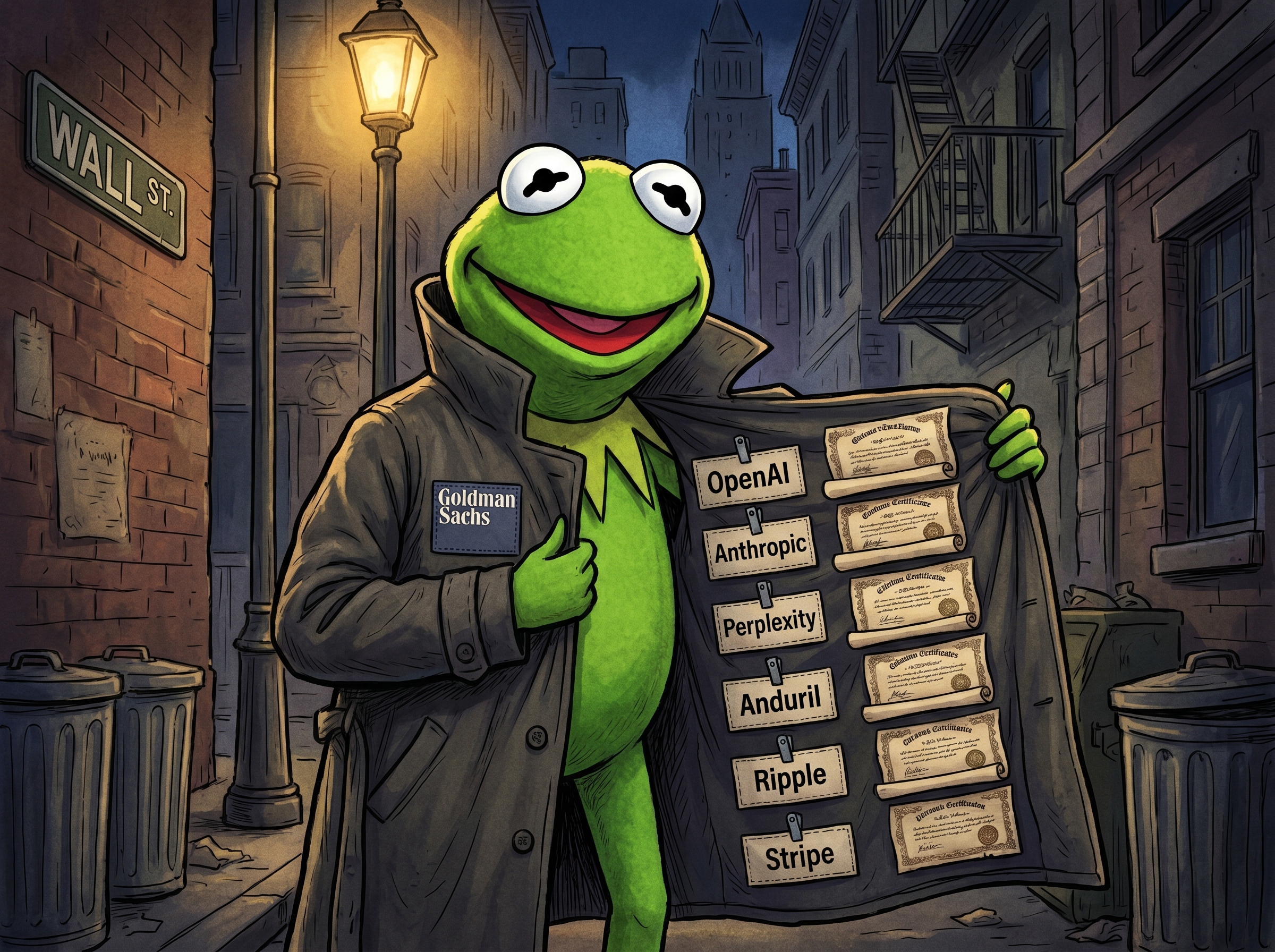
The SPV Party for AI Stocks is Over. But some Investors won’t find out until it’s too late.
Some things never change and everyone wants "in" on a good deal. In the early 2010s the private markets were aflutter with opportunities to buy Facebook, Twitter and Uber stock in the private market before their IPO. Early on, some lucky investors were able to buy these shares directly from former employees but others, had to buy from dark pools of capital called Special Purpose Vehicles ("SPV"s). For a long time, the SPV was the smartest workaround in private markets. It let sophisticated investors into companies that were never supposed to be accessible to them. It helped Wall Street's elite clients buy Facebook shares years before the IPO. It gave early AngelList syndicates the architecture to pool capital into unicorns before the term "unicorn" even existed.
Now, in May 2026, Anthropic and OpenAI have both issued formal warnings that effectively void any SPV-based access to their shares lacking explicit board approval. The SPV playbook that worked for a decade is breaking down, and it's breaking down in ways that could leave investors holding contracts worth nothing.
How the SPV Became the Standard Tool
The modern pre-IPO SPV traces its origins to a specific moment: January 2011, when Goldman Sachs announced it was creating a special purpose vehicle to give its wealthiest clients exposure to Facebook. Goldman had invested $450 million directly into Facebook alongside Russian firm DST, valuing the social network at $50 billion. Rather than stop there, Goldman wanted to raise another $1.5 billion from its high-net-worth client base, investors willing to put in a minimum of $2 million each.
The SPV was the legal mechanism that made it possible. Under Section 12(g) of the Securities Exchange Act of 1934, companies with more than 500 shareholders of record and $10 million in assets had to register with the SEC and file public financial disclosures. The SPV sidestepped this entirely. Because it was a single LLC managed by Goldman, it counted as one shareholder of record, regardless of how many clients pooled money inside it. Thousands of investors, one entry on the cap table.
The SEC took notice. Regulators questioned whether Goldman and Facebook were deliberately circumventing disclosure rules. Goldman ultimately pulled U.S. investors from the offering and directed the $1.5 billion raise offshore to non-U.S. clients. Facebook acknowledged the regulatory pressure by agreeing to register with the SEC by April 2012 anyway. The deal closed. Goldman's clients made money. The SPV had just received its biggest advertisement in history.
The JOBS Act of 2012 raised the 500-shareholder threshold to 2,000. Companies could now stay private indefinitely. That single regulatory shift birthed the "stay private longer" era and an entire industry of SPV platforms built to provide secondary market access.
AngelList and the Democratization Phase
AngelList formalized the SPV into a repeatable product. A syndicate lead could identify a deal, form an LLC, raise from accredited investors under Regulation D Rule 506(b) or 506(c), and send everyone their K-1 at year end. Setup costs ran around $8,000–$10,000 per vehicle. Platforms like Forge Global, EquityZen, and Hiive built brokerage infrastructure on top of this architecture, matching buyers and sellers in secondary transactions and wrapping the transfer in SPV structures to accommodate smaller investors.
For a decade it worked. Twitter employees got liquidity. Uber shareholders sold ahead of the IPO. Airbnb insiders found buyers at valuations that proved conservative. The SPV became so routine it felt institutional.
Then the fees crept up. Goldman's original 4% upfront plus 5% carry evolved, by the AI era, into managers charging 16–20% on deals involving OpenAI or Anthropic. Some structures layered multiple SPVs: a vehicle to hold the shares, another to pool LP capital into the first, sometimes a third offshore. Each layer extracted its own fees. Investors rarely saw the full stacking until distribution documents arrived years later.
What Anthropic and OpenAI Just Did
Both companies updated their share transfer policies in May 2026 with nearly identical language: any sale or transfer of their shares that has not received explicit board approval is void and will not be recognized on their books and records. The prohibited structures they named are comprehensive, covering direct secondary sales, SPVs, tokenized equity, and forward contracts.
Anthropic went further, publishing a list of eight named platforms it considers unauthorized: Open Doors Partners, Unicorns Exchange, Pachamama Capital, Lionheart Ventures, Sydecar, Upmarket, Hiive, and Forge Global. Both Forge and Hiive disputed their inclusion and stated they only facilitate issuer-approved transfers. Forge went so far as to request Anthropic remove its name from the list. Even the most regulated secondary platforms are now caught in the middle of a policy that applies retroactively to deal structures already in progress.
Three specific issues are creating real exposure for investors right now.
Voided Sale Contracts
If a seller transferred shares to an SPV without board approval, the transfer is void under the companies' transfer restrictions. The buyer owns an interest in an SPV that holds nothing. Delaware law adds complexity: transfer restrictions imposed after shares were originally granted may require holder validation before enforcement, which is why Anthropic is unlikely to pursue aggressive legal action. That uncertainty does not help a buyer who paid a premium price for LP interest in a vehicle the issuer refuses to recognize.
Fee Stacking in Multi-Layer SPVs
Some clever SPV sponsors structured transactions with multiple layers, creating funds that own funds that claim to own shares. And since each SPV has its own fee structure (management and carry) a multi-SPV fund creates fee stacking at each level. An investor paying 10% carry on the outer vehicle may not realize the inner vehicle carries its own 10% interest. At $300 billion-plus valuations, the economics look attractive enough to obscure the math until distribution. With both companies now disputing the underlying ownership chains, LPs in multi-layer structures face the worst outcome: fees extracted, shares unrecognized.
Forward Sale Default Risk
In order to circumvent these rules, some clever investment banking types will find a way to help former employees monetize their ownership. One such method is the use of a forward contract. A forward contract is an agreement by a current shareholder to deliver shares at a future date, typically at IPO or a subsequent funding round, at a pre-agreed price. Shareholders used these structures to monetize their position without a formal transfer that would trigger right of first refusal. The problem is default risk. If the underlying transfer is declared void, the seller has no enforceable delivery mechanism. The buyer holds a contract with no counterparty performance. Some of these forwards were written with limited recourse, meaning recovery against the individual seller is capped or unavailable. Many shareholders who entered these agreements are now subject to extended lockup provisions introduced by OpenAI's 2025 restructuring from capped-profit to full for-profit. The number of potentially stranded forward contracts is not small.
What This Actually Means
The SPV was always a workaround. Goldman knew it in 2011. The platforms that came after knew it too. What changed is that the companies being accessed are now large enough, and legally sophisticated enough, to close the gap.
Any investor evaluating a current offering claiming SPV-based access to Anthropic or OpenAI should demand one thing before capital moves: written confirmation from the company's board that the underlying share transfer was approved. Not platform assurances. Not SEC registration of the SPV itself. Actual board authorization. Without it, 15 years of SPV innovation is precisely that: history. Because as with everything in the capital markets, the devil is in the details and caveat emptor still resides
