
Israel, the Original Deep Tech Nation
I recently attended a number of Deeptech Week events organized by Startup Nation Central last week. This is a summary of my thoughts and findings from this week.
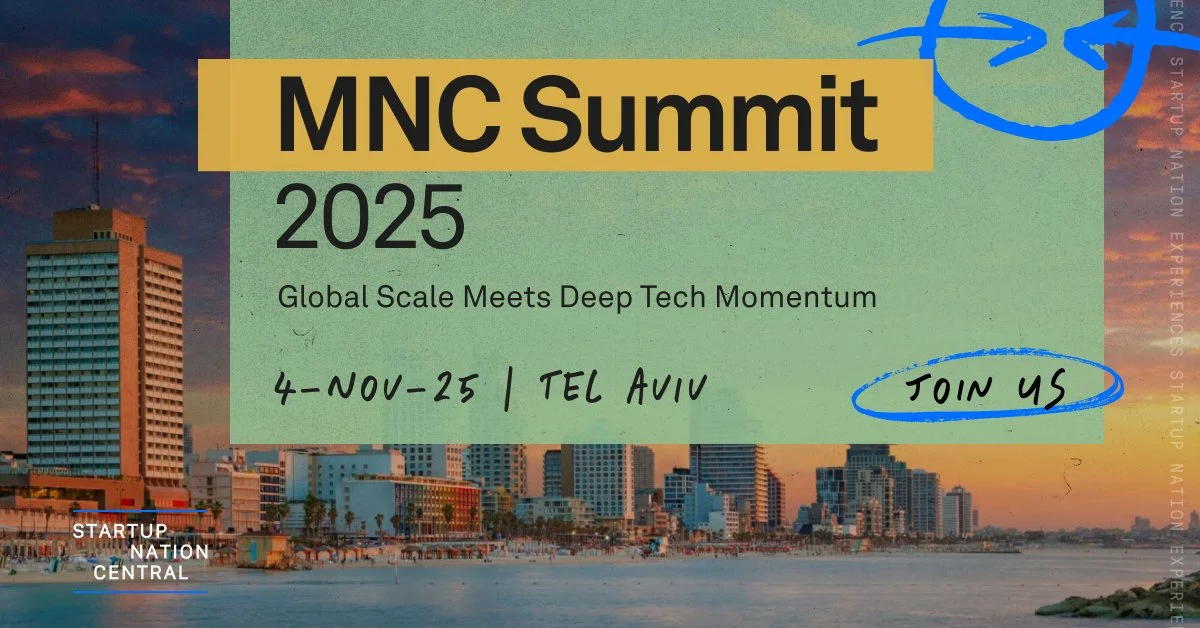
MNC Summit 2025 - Global Scale Meets Deep Tech Momentum, Tel Aviv. Source: Startup Nation Central
What is Deeptech?
One of the first panels of the day described Deeptech as the series of technologies that were born from extensive research operations before any development actions could take place.
Often, but not exclusively, Deep technologies have hardware, software and interactive components that reshape and rethink the manner in which data and activities are processed.
The week was filled with discussions about Energy, Infrastructure, Physics, Chip design and their translations into photonics, batteries & energy management, quantum computing and, of course, applied artificial intelligence.
So while the term “Deeptech” is somewhat new in Venture-land speak, it’s basically the creation of “stuff” that solves real world problems by combining novel methods in hardware, software and energy design.
Quantum Computing
My favourite classes in business school were often related to management science, operations research and statistics, so I am keen to learn as much as I can about quantum computing and part of why I attended this extensive session run by Deeptech Nation, Qubit, DDR&D at Pearl Cohen’s event site.
As a layman, the physics related to quantum computing are outside the scope of my understanding as of this writing. What I do clearly understand from the lecture given by Professor Serge Rosenblum from the Weismann Institute, is that quantum computing is a new architecture to solve existing and new problems in a non-linear fashion. As a result, quantum computing processes solve complex problem sets in significantly less time than current linear computing methods and using less energy. So literally, 1 + 1 could equal 57.
And while there are challenges to the physical creation of quantum computers and their networks, the advances in materials, energy management and chip design provide an opportunity for us to build faster and cheaper systems almost every few months.
From an investor perspective, there are few quantum computing focused investor groups, but there are quantum specialists that are developing in some of Israel’s most prominent VCs like Aleph VC, Pitango, PSG (who spoke of their journeys). I specifically appreciated the discussion provided by Dorit Dror from Qbeat Ventures because she followed Professor Rosenblum and gave the audience and myself some practical applications of Quantum in ‘the wild’ and a number of the opportunities and challenges. As the former CTO at CheckPoint, she clearly has a grasp of the technical requirements for Quantum systems as well as a business unit.
The applications for Quantum computing are extensive and will likely touch areas of our research in the coming months as we publish more reports related to Industrial Technology, Defense, Cyber and Medical industries.
AI is everywhere
Israel is no longer just the StartUp Nation, it is the AI Nation.
As I noted during my review of StartUp Nation Central’s AI Adoption report, Israel tech and business leaders are adopting and adapting AI to their core business processes in greater degrees than their ROW counterparts.
Artificial intelligence (AI) methods, tools and processes were described in pretty much every presentation I attended and people that I spoke with.
But what was more intriguing is that we weren’t talking about network structures, language or data models.
My conversations and presentations were about the application of AI towards the completion of activation of real work in the real world. Whether it was drug development, circuit board design, supply chain optimization or manufacturing, every person was conscious about how AI can help accelerate and optimize their operations.
Great companies, doing important work
There are great Israeli companies with great leaders operating in the DeepTech ecosystem
I met with or attended panels with the leaders from StorDot, Magnus Metal, Lava Energy, Boson Energy, Moonshot Space, Xtend Defense, IMMUNAI that are all committed to building offerings that will have ground breaking functions for end-user consumers or OEMS that will build products for the masses.
And this is a small subset of the companies that were present at various Deeptech events I attended.
Deeptech Investors are committed
Investors were in attendance at each session and on most of the panels that I attended. An interesting combination of Corporate Venture leaders (IBM, Telus), established Israeli Venture Groups (Pitango and Aleph), Venture Studios (Ignite Spark, Epsilon Climate, Google Startups), Government entities (DDR&D, New Mexico Sovereign Wealth) and specialty investors (Protego, Qbeat, Earth & Beyond Ventures) provided the backdrop for some of the most interesting conversations I’ve had with those deploying capital into these types of companies.
What struck me amongst all these conversations is the understanding that these technologies and their companies will require extensive time to achieve any level of commercial opportunity and that technology and execution risk were of equal importance in understanding where to deploy capital.
As such, these investors are judiciously choosing their investments carefully despite the plethora of early-stage companies that are being created throughout the entire country.
Parting thoughts
As I began Deeptech week on November 5th, I was uneasy about the time investment but came with an open mind to learn. As a result, I saw and learned a ton about technologies that will drive the real world forward in the coming decades and some of the investors and operators who’ll be driving them. All in all, it was time well spent.
And I’m grateful for StartupNation Central and the other sponsors, venues and groups that help build this week of events into something fascinating and actionable.
