
What is going on with the NIS?
Our analysis suggests, it’s gonna be lower for longer
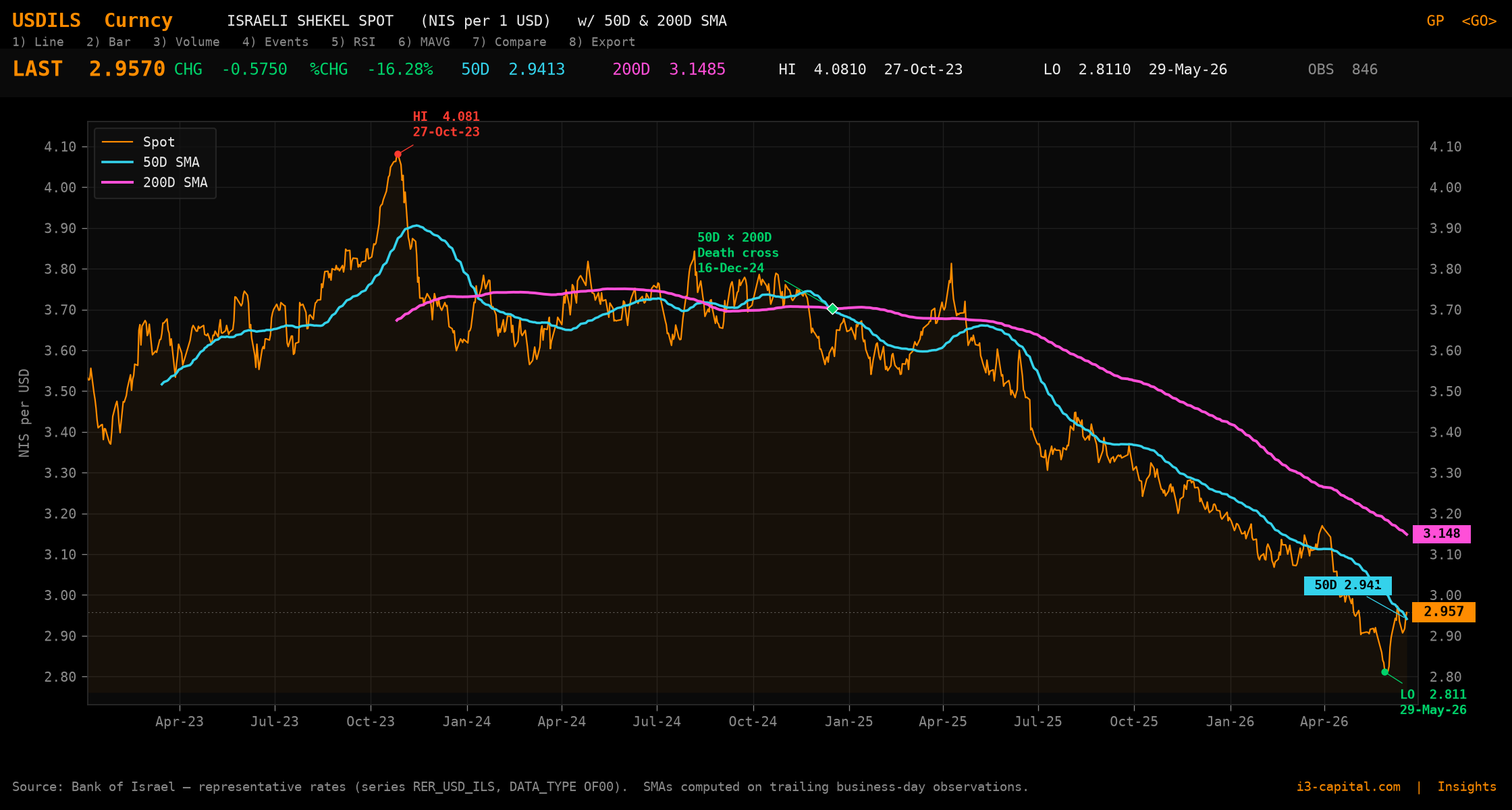
In case you've been stuck in a bunker for the last 18 months (that's totally possible), you'll realize that the New Israel Shekel (NIS or Shekel) has appreciated dramatically against its US counterpart, the US dollar (USD). There have been a number of articles posted on X and other Social Media platforms as well as articles in CalcalistTech and Globes about the challenges of this change of rate. I was curious of the cause of this dramatic shift and as result, I did what most analysts would do, I looked at the numbers.
I've recently completed an extensive study on the relationship between the NIS and US dollar. I did so because it appears that there's been a dramatic change in the way the Shekel has been performing against the USD and the number of my friends, colleagues and client companies have been changing their behaviors as a result of this change in the exchange rate.
As a result of this analysis and study, I have recently published a 50-plus page paper in the research section of our site.
I'll spare you in 50 pages of details and provide you with a quick summary of my findings here.
THE STUDY AND THE OUTCOME
I reviewed the performance of the exchange rate from the beginning of 2019 until June 6th of this year because I wanted to include the entire pre and post COVID periods.
My initial interest in this topic was because I thought that the majority of the cause for NIS dramatic appreciation was the USD reverting back to the exchange rate before COVID. The results showed that this is truly the case for the period from 2023 to 2024 but not thereafter. Something else was afoot.
My findings show that from 2019 to 2023, 80% of the change in the NISUSD rate is caused by changes in the overall rate of the US dollar in relation to all other currencies. This is a classic "shipping inflation" outside of your country scenario and started shortly after the COVID period in late 2023 into 2024.
The other 20%, and this is material because it explains the movements over the last 14 months, relate to foundational changes in both the stock and the flow of US dollars that come to Israeli companies primarily in the export and high tech industries.
STOCK & FLOW EXPLAINED
As we've seen from the media, despite the 7 front war, Israeli technology companies have raised billions of dollars for their business plans (Cyera, Drivenets, Decart) and received billions more for the purchase of their businesses (Wiz, Aramis, CyberArk, Dustphotonics). This has created a stock of USD inventory held by Israeli companies to be used for the purposes of funding their operations or for the payment of fees, services and most importantly remittances of taxes and payroll for existing Israeli operations.
In addition, Israeli domiciled companies receive over $50 billion per year in revenues from customer sales and exports. As I have estimated that these companies are converting approximately 8% of their total USD stock per year to help fund their operations. These sales revenues and stock conversions create the flow of USD entering the Israeli ecosystem of approximately $5 billion per month.
I then asked myself, how does this monthly flow of conversions relate to the NISUSD forex market. According to the Bank of Israel, the average daily NIS USD forex market comprises approximately 2 to 3 billion in USD (or approximately $50 billion per month). Thus the annual amount from revenues and stock conversion (approx 65B USD) represents just over one month of forex trading volume.
THE CARRY TRADE ANALYSIS
After the paper was published, a number of colleagues of mine suggested that the relationship between this NIS USD rate and the change in real interest rate had some causal relationship. I reviewed this, and while the data suggested there was a correlational relationship, I dug deeper to see if there was a causal relationship. And the typical relationship would be related to a potential carry opportunity between Israel and US interest and foreign exchange rates.
A typical carry transaction consists of borrowing 1 million US dollars, converting it to NIS and investing this NIS equivalent into a one year Israel treasury note and then converting it back into US dollars at the end of the term. While we estimated using spot rates, a FX forward transaction could easily facilitate and lock in any potential gains or losses. A reverse carry trade would consist of borrowing 1 million NIS and investing it in the US dollars.
Upon reviewing the one year Treasury note rates between Israel and the US for the period of 2019 to today, I found the interest rate differential was immaterial as it related to potential returns on a traditional forex carry forward trade. In fact the majority of the gains and losses that could be incurred happened as a result of changes in the forex rate. The 'carry trade' did not materially explain the underlying reason for the dramatic change in the forex rate.
So my primary thesis today as to why NIS has appreciated so significantly against USD is because of these stock and flow transactions on 15% of the total volume of the current forex market. Sadly, most Israeli company CFOs are not actively hedging their USD exposure and are accepting spot rates for each month as they need NIS for their payroll and Israeli related expenses.
THE FALLOUT
Higher NIS to USD means that exports are more expensive in relative terms to previous years. It also means that the relative wage and cost opportunities that existed in Israel before 2024 are no longer available (My analysis of high-tech worker wages between the US and Israel suggest that any arbitrage opportunity between the two has evaporated).
When I examined the tax receipts of the ministry of finance in relation to other OECD countries and found that Israel's tax regime is primarily focused on receiving funds from VAT and other consumption taxes and fees equally with corporate and personal income taxes. This implies that as imported goods become cheaper in NIS, less VAT is collected and potential capital gain receipts are lower because the majority of such gains are itemized in USD which is of lesser value than in previous periods.
HOW ISRAELI COMPANIES ARE REACTING
From reviewing media articles and conversations with Israeli management teams, companies who primarily receive their receipts in the form of USD are now closely examining their cost structures. The result is slower or reduced hiring in Israel and opportunities to hire and build outside of the country. Companies that are more domestically oriented, have had little to no impact on their real revenue lines but have had positive reduction in expenses related to increased NIS purchasing power for imported goods and services.
Accordingly, domestic companies have been able to maintain their margins at lower NIS prices but companies that are more export oriented (like hitech) have been hammered on their operating margins.
And since Israeli export oriented CFOs have been asleep at the switch regarding their foreign exchange management (because they have only been converting one month at a time at the spot rate) the initial impact is minor. But the overall impact is major (I estimate a compression of operating margins in excess of 50% for Israeli domiciled companies) and now the Boards are paying attention.
POLICY OPTIONS FOR THE BANK OF ISRAEL
Israel Central Bank is in a quandry, despite the fact that inflation is falling closer to its lower bound of 1%, any material change in the primary interest rate will have little impact on the NISUSD rate due to the stock and flow impacts I've discovered. Moreover, as exhibited in the recent May in forex intervention, wherein the Bank of Israel purchased 800 million US dollars, their forex activities have had little to no impact on the actual exchange rate.
And while employment remains robust in the economy, there are two employment challenges. The first relates to markets that are impacted by the forex, and the second is more domestic oriented markets that are not related to the forex rate.
So a measured approach of interest rate management, forex management and the ability of export focused companies to pay their remittances in USD will alleviate some of the pressure on the NISUSD rate. All are required to be effective.
As a result of my analysis, I will be estimating the NISUSD rate for the next 18 months to range between 2.95 and 3.15. So, in short, a lower rate for longer.
