
Quantum Stack, Not the Chip
Part four of a four part series on quantum and photonics. Here is what is actually being built in Israel, by whom and with whose money.
In the first three posts of this series I kept coming back to one line: Israel is not going to build the million qubit processor, it is going to build the layers around it. This post puts flesh on that line. It is drawn from an industry briefing I sat with this week and checked against primary sources.
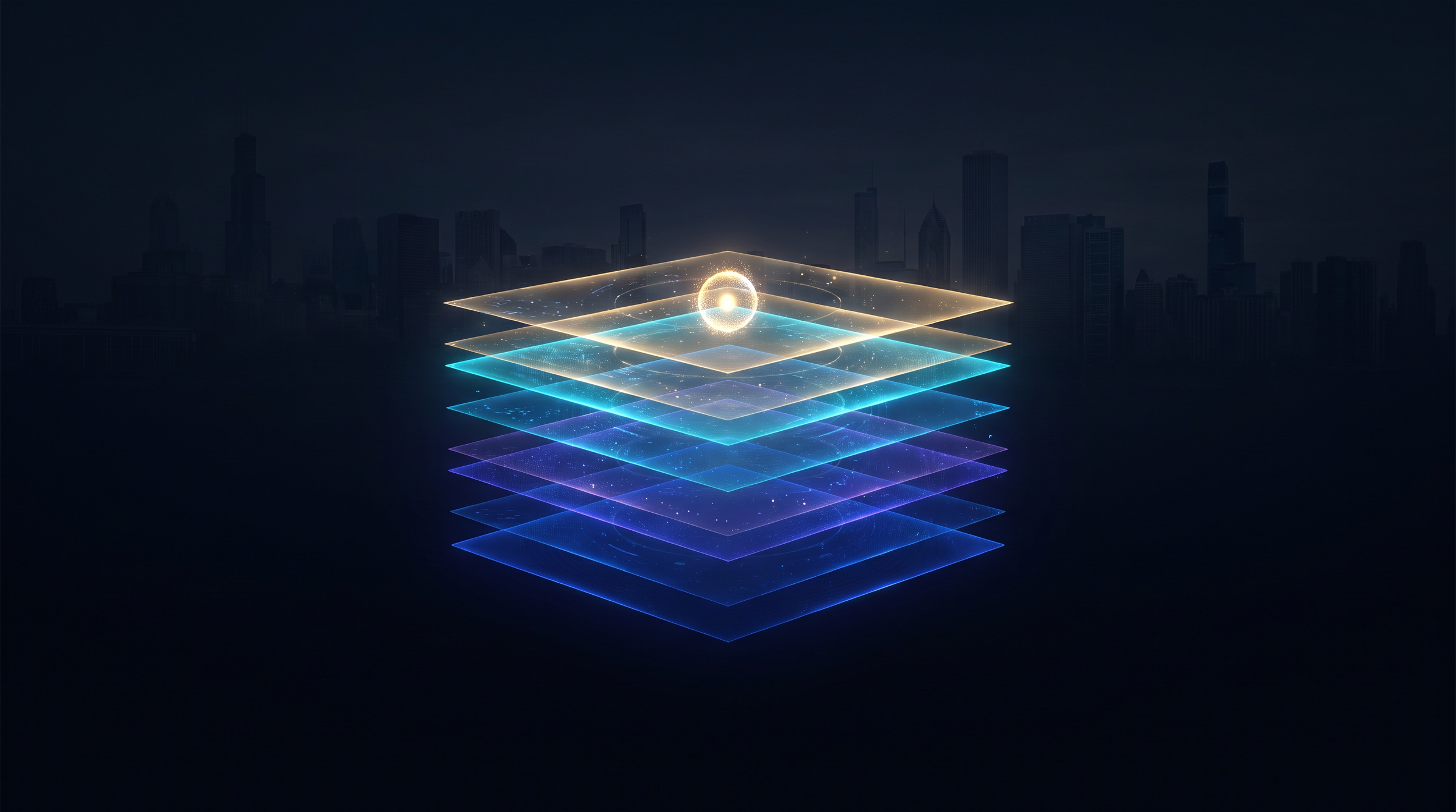
Israel's national bet is to own the layers around the qubit, the control, the compilers, the error mitigation and the shared testbed, rather than the qubit itself. It is the same bet the country made in cybersecurity and semiconductors. Own the layer everyone needs. Let other people fight over the headline hardware.
The national program
The Israel National Quantum Initiative, INQI, is the umbrella organization for quantum activity. It’s a multi agency government effort across quantum computing, sensing and communication, funded jointly by the Council for Higher Education, the Ministry of Defense, the Ministry of Finance, the Ministry of Innovation, Science and Technology and the Israel Innovation Authority. The core multi year program was on the order of NIS 1.25 to 1.5 billion, roughly $350 to 400 million, over five to six years, according to the briefing, formalized around late 2019 and 2020. Relative to the United States, China and the EU Quantum Flagship, that is modest. Private venture has been the multiplier.
The man who ran the initiative in its formative years was Dr. Tal David, an experimental physicist who came out of Israel Aerospace Industries and the Ministry of Defense quantum portfolio. He is now co founder and CEO of Quantum Art, the trapped ion company. That detail matters. The person who shaped the national program went on to build one of the companies it was designed to spawn. The original envelope largely concluded around late 2024 and 2025. A follow up committee was appointed in 2025, and the Innovation Authority put out a call of about NIS 100 million, roughly $33 million, for a national multi platform quantum testbed, while the National AI Directorate ran a separate tender, called Project Nexus, for a sovereign Israeli technology quantum computing platform, as the briefing describes.
The Center
The flagship is the Israeli Quantum Computing Center, the IQCC, on the Tel Aviv University campus. It opened on June 17, 2024 and is operated by Quantum Machines, as a core part of the Innovation Authority's National Quantum Initiative. The stated purpose is not to field a single national champion computer. It is to give Israeli academia, startups and industry a shared, multi-modality testbed and full stack development environment, with prioritized access for Israeli users and cloud access for international researchers. Forbes called it a pioneering facility on a global scale. The Times of Israel noted it opened amid the current war.
What makes it unusual is the architecture. The IQCC is a quantum data center, not a standalone machine. Multiple co-located processors of different qubit types sit behind a common Quantum Machines OPX and OPX1000 control stack, an on premises HPC cluster, an NVIDIA DGX Quantum system for low latency quantum classical coupling and AWS cloud connectivity. Initial systems included a roughly 25 qubit superconducting processor from QuantWare and an 8 qumode photonic system from ORCA Computing. In December 2025 the center became Qolab's first international installation for its superconducting qubit device, the company founded by 2025 Nobel Physics laureate John Martinis, with additional Qolab systems in Madison, Wisconsin reachable through the IQCC cloud. Partners include QuantWare, ORCA, NVIDIA, ParTec, Classiq, AWS and Elbit Systems.
The IQCC is the point of the whole national strategy. It lets Israeli firms specialize in layers of the stack without each building isolated cryogenic and HPC infrastructure. The center serves more than 30 customers, including all of Israel's leading research universities. The heavy infrastructure is shared. Israeli companies compete on the layer they chose.
The companies, layer by layer
The control layer is Quantum Machines, founded in Tel Aviv in 2018 by Itamar Sivan, Yonatan Cohen and Nissim Ofek, all out of the Weizmann circle around Moty Heiblum. Its $170 million Series C in February 2025 brought total funding to $280 million, with PSG Equity and Red Dot Capital on the cap table, and it builds the control electronics that run quantum labs worldwide. It is also the operator of the IQCC. If you accept the frame that the stack is the moat, Quantum Machines is the company that already proved it. Quantum Machines says its control technology is used by a majority of companies developing quantum computers.
The software layer is Classiq, the quantum software compilation company, which raised $110 million in a Series C. Classiq's founders are Nir Minerbi, Amir Naveh and Yehuda Naveh. Its job is to take a quantum algorithm and compile it down to the gates a real machine can run, a layer that matters more as machines get bigger.
The error mitigation layer is Qedma, founded out of Hebrew University and led by Professor Dorit Aharonov, one of the people who proved the fault tolerance threshold theorem. Qedma raised $26 million in a July 2025 Series A led by Glilot+, with IBM participating. Mostly based on Aharonov's presence because she’s the theorist who helped define what fault tolerance means. She’s now building the software that gets you closer to it on noisy hardware.
Then there are the hardware bets: Quantum Art, announced a $100 million Series A in December 2025 and extended that round to $140 million in April 2026, led by Bedford Ridge Capital with Battery Ventures and others, plus returning Israeli funds Amiti, StageOne, Vertex and Entrée, plus the Weizmann Institute itself. Its CEO is Tal David, the former head of INQI. Its CSO is Professor Roee Ozeri of Weizmann, who built Israel's first lab scale full stack trapped ion computer. QuamCore is the superconducting bet, led by CEO Alon Cohen, claiming a simulated architecture for a million qubits in a single cryostat, which raised $26 million in a Series A in August 2025, $35 million total including a $4 million Innovation Authority grant, led by Sentinel Global with Arkin Capital, Viola, Earth and Beyond and Qbeat Ventures. Qarakal, the superconducting company run by Nissan Maskil out of the IAI and ELTA world, with Professor Nadav Katz of Hebrew University as CTO, is part of this superconducting push. Maskil chairs the Innovation Authority's quantum consortium. Q-Factor, working on Rydberg optics and quantum memories with Professor Ofer Firstenberg of Weizmann as Chief Scientist, was seeded with backing from NFX and Intel Capital. The defense primes, IAI Elta, Rafael and Elbit Systems, run the dual use sensing and secure communication work that falls out of the sensing and cryptography pillars.
The communications pillar
The computing stack is half the story. The other half is the cryptography pillar, the part of INQI that worries about what happens to communications when quantum computers get good enough to break the encryption the world runs on.
In August 2026 the Innovation Authority's Technological Infrastructure Division stood up a new Post Quantum Communications consortium, nine companies and six universities working on post quantum cryptography, quantum key distribution and hybrid systems across optical, Ethernet, mobile, satellite and data center networks. Allot chairs it. The company roster is Ceragon, Classiq, Gilat Satellite Networks, Heqa, Elta, Nvidia, RAD and Ribbon, alongside Bar Ilan, Ben Gurion, the Hebrew University, the Open University, the Technion and the University of Haifa.
The reason to pursue all three, PQC and QKD and hybrid, rather than betting on one, is that communications networks are layered, and a weakness anywhere in the chain undoes the security of the whole. Classiq compiles quantum programs for the computing stack alongside the cryptographers. The two stacks are not separate. QKD runs on the same fiber and the same photonics the rest of this series is about. The communications pillar is where the photonics railroad from part two meets the part of the market that has to be sold before the qubits even arrive, because the data being protected today has to stay safe for decades.
The people
This is the part that tells you the bet is serious. The academic bench behind these companies is the Israeli physics establishment. Heiblum at Weizmann, the 2025 Wolf Prize winner and mentor to the Quantum Machines founders. Aharonov at Hebrew University. Ozeri at Weizmann. Ido Kaminer and Moti Segev at the Technion. Ron Folman at Ben Gurion. Barak Dayan, Firstenberg and Nir Davidson at Weizmann. Katz at Hebrew University. These are not adjuncts. They are the people whose names are on the theorems and the first experiments. The fact that they are now on cap tables and corporate org charts, not just papers, is the signal that the stack, not the chip, is becoming a real industry in Israel.
Commercial Quantum applications
It would be remiss to not describe companies that are building quantum products and applications. At the forefront of the market is Quantum X Labs (NASDAQ:QXL) which joined the Nasdaq in March 2026. QXL, from it’s lab based in Tel Aviv, is acquiring and commercializing five distinct applications for quantum technologies: error analysis and correction for quantum computing hardware, NMR gyroscope hardware to reduce GPS dependency, a Quantum Clock for satellite calibration, Cold atom computers and Nuclear Quantum algorithms that reduce imaging sample requirements for patients.
The capital
The money is following. CTech listed five Israeli quantum financing rounds in 2025 totaling $432 million, based on the round sizes it reports. The generalist Israeli funds, Amiti, StageOne, Vertex, Entrée, Viola and Earth and Beyond, are all in. The strategics are here too, Intel Capital on Quantum Machines and Q Factor, NVIDIA adjacent through the IQCC and DGX Quantum. And in January 2026 a dedicated fund appeared, Qbeat Ventures, Israel's first venture fund focused exclusively on quantum, initially founded by Dorit Dor, the longtime CTO of Check Point, Maya Racine Netser and Joab Rosenberg, a former Talpiot commander with quantum research at Weizmann (Joab now runs the Quantum strategy at Deep33 Ventures). Its January first close named Dorit Dor, Maya Racine Netser and Noam Bracha as managing partners. It targets $100 million and closed a first $20 million, with Shlomo Kramer among the backers, and its portfolio already includes Quantum Art, QuamCore, Orange Quantum Systems and QIZ Security.
A dedicated quantum fund is the clearest tell that a sector has crossed from research program to investable market. Israel now has one. Conversations with other investors suggests that Quantum and Photonics are on their mind and we suspect that many more investors will follow with Quantum related strategies.
Conversations about about de-SPAC opportunities for the largest Quantum companies are floating around boardrooms and law offices and a multi-billion dollar transaction appears to be in the works.
Final Thoughts:
The Israeli quantum story is not a story about who builds the best qubit. It is a story about who builds the layers that make every qubit usable, the control electronics, the compilers, the error mitigation and the shared testbed that lets a small country compete without buying every machine.
The national program put in the seed capital, the IQCC put in the shared infrastructure and a generation of physicists who used to publish only papers are now on cap tables. Investors are building Quantum-first strategies and capital is being deployed.
The stack, not the chip, is the bet. And the bet, as of 2026, is that the country that owns the layers around the qubit will matter more than the country that owns the qubit itself. Quantum Art and QuamCore are the exceptions that test the rule, the Israeli hardware bets that say even on the qubit itself, Israel will not be absent. But the spine of the story is Quantum Machines, Classiq and Qedma, the control, the compilation and the error mitigation. That is where Israel is already generating revenue, already exporting and already where I would put the attention of anyone watching this market.
