
Defensetech Jargon: TRL explained
I don’t know who uses more acronyms and Jargon than the Defense and Aerospace Industries. As I began to talk to investors and creators I kept hearing the same acronym and never really understood it. That Acronym is: TRL and it means the Technical Readiness Level of a product or solution, so let’s dive in and learn more about this.
If you work in the defense sector, you’ve almost certainly run into the Technology Readiness Levels (TRL) framework. It’s one of those essential but underappreciated tools that helps turn promising scientific ideas into reliable, mission-ready systems. Developed originally by NASA and widely embraced by the U.S. Department of Defense, the TRL scale provides a standardized 1-to-9 metric for assessing technology maturity. In an industry where billions are at stake and delays can have strategic consequences, this common language for measuring progress is invaluable.
The scale begins at the very beginning and builds toward fully operational capability. Early levels focus on discovery and proof-of-concept, while later stages emphasize rigorous testing in increasingly realistic conditions. This structured progression allows program managers, contractors, and decision-makers to better understand risk, allocate resources, and set realistic milestones.
The TRL system described:
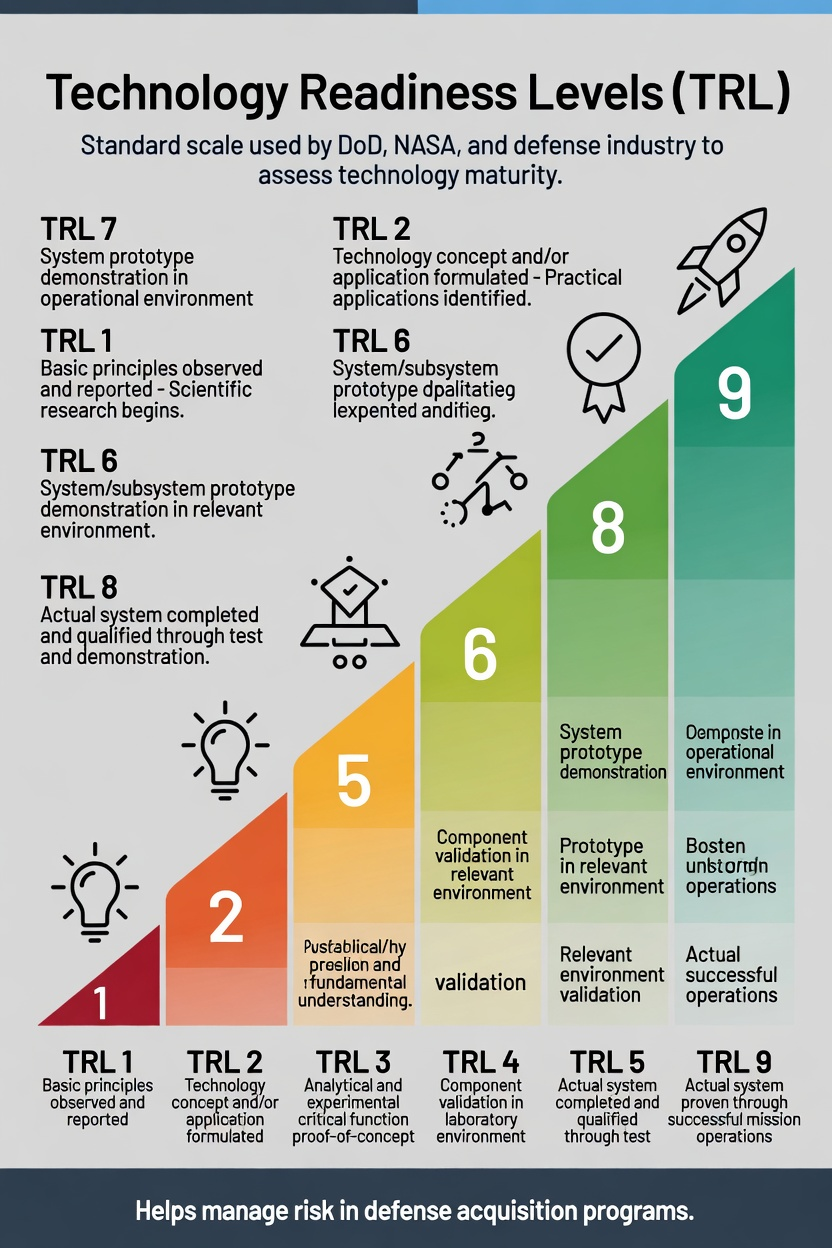
TRL 1: Basic Principles Observed and Reported
This is where it all starts. Someone spots a fundamental scientific truth, maybe it’s a new way materials behave or an interesting physical effect, and writes it down. No products, no applications, just raw discovery. In defense terms, it could be the first hint of something that might one day become better stealth coatings or advanced sensors.
TRL 2: Technology Concept and/or Application Formulated
Now people start asking the big "what if" questions. They begin linking that basic science to actual problems worth solving. You're still in the realm of concepts and white papers, but the direction is starting to take shape. This is where a lot of exciting ideas for new propulsion or smarter AI decision tools first appear.
TRL 3: Analytical and Experimental Critical Function Proof-of-Concept
Things get real here. Teams run calculations, build simple models, and run lab tests to show the core idea actually works. It's still early, but you've moved past theory into evidence.
TRL 4: Component and/or Breadboard Validation in Laboratory Environment
This is when you start bolting pieces together and testing them in a controlled lab. Many promising technologies hit their first real wall at this stage. What worked beautifully in a simulation often behaves differently once you have physical hardware in the mix.
TRL 5: Component Validation in Relevant Environment
Now we're pushing things harder. Components get tested in environments that actually resemble real use — wind tunnels, vibration tables, electronic warfare simulations. This step matters because lab conditions can be misleadingly kind.
TRL 6: System/Subsystem Prototype Demonstration in Relevant Environment
At this stage you’ll find a more complete prototype working in a high-fidelity setting. A lot of defense programs use this as a major decision point before sinking serious development dollars into something. The risk drops noticeably once you reach this level.
TRL 7: System Prototype Demonstration in Operational Environment
This is the gut check. Your prototype goes into actual operational conditions — on real aircraft, ships, or during live exercises. Failures here hurt, but they're still cheaper than discovering the same problems after you've started full production.
TRL 8: Actual System Completed and Qualified Through Test and Demonstration
The technology has reached its final form. It's been tested, qualified, and documented to meet all the expected requirements. Manufacturing plans are solid. You're basically ready to build it.
TRL 9: Actual System Proven Through Successful Mission Operations
The top of the mountain. The system isn't just working in tests — it's proven itself across multiple real missions under tough conditions. This is what "battle-tested" actually looks like.
Why does TRL work?
What I really like about the TRL approach is how clearly it shows the trade-off: as you climb the levels, complexity goes up and risk goes down. Programs that try to rush low-TRL technologies into big acquisition phases almost always pay the price in massive cost overruns and delays. That's exactly why the US DoW pushes hard to get critical technologies to TRL 6 or better before moving into full-scale development.
Smart teams don't rely on TRLs alone. They pair them with Manufacturing Readiness Levels to make sure something that works can also be built reliably and affordably. It's a painful lesson many programs have learned the hard way.
The framework also helps beyond single projects. Allied nations are increasingly using similar scales, which makes joint programs run smoother. For smaller companies and startups, knowing exactly where their tech sits helps them chase the right funding at the right time — whether that's early research grants or bigger production contracts.
Look around at today's defense challenges — hypersonics, directed energy weapons, autonomous systems, quantum tech — and you quickly realize why this kind of disciplined thinking matters more than ever. The TRL scale forces real evidence instead of wishful thinking. It gives engineers and leaders a shared way to talk about progress and remaining risks.
Next time you're reviewing a proposal or technology roadmap, ask yourself the same questions the pros do: Where does this really sit on the scale? What's the actual evidence? And what risks are we still carrying forward?
At the end of the day, defense innovation has always been about turning lab breakthroughs into tools that work when it counts. The TRL framework remains one of the clearest, most practical roadmaps we've got for making that leap successfully. In a world where getting it wrong can have serious strategic consequences, that kind of clarity is hard to replicate in other industries.
