
From Bits to Qubits
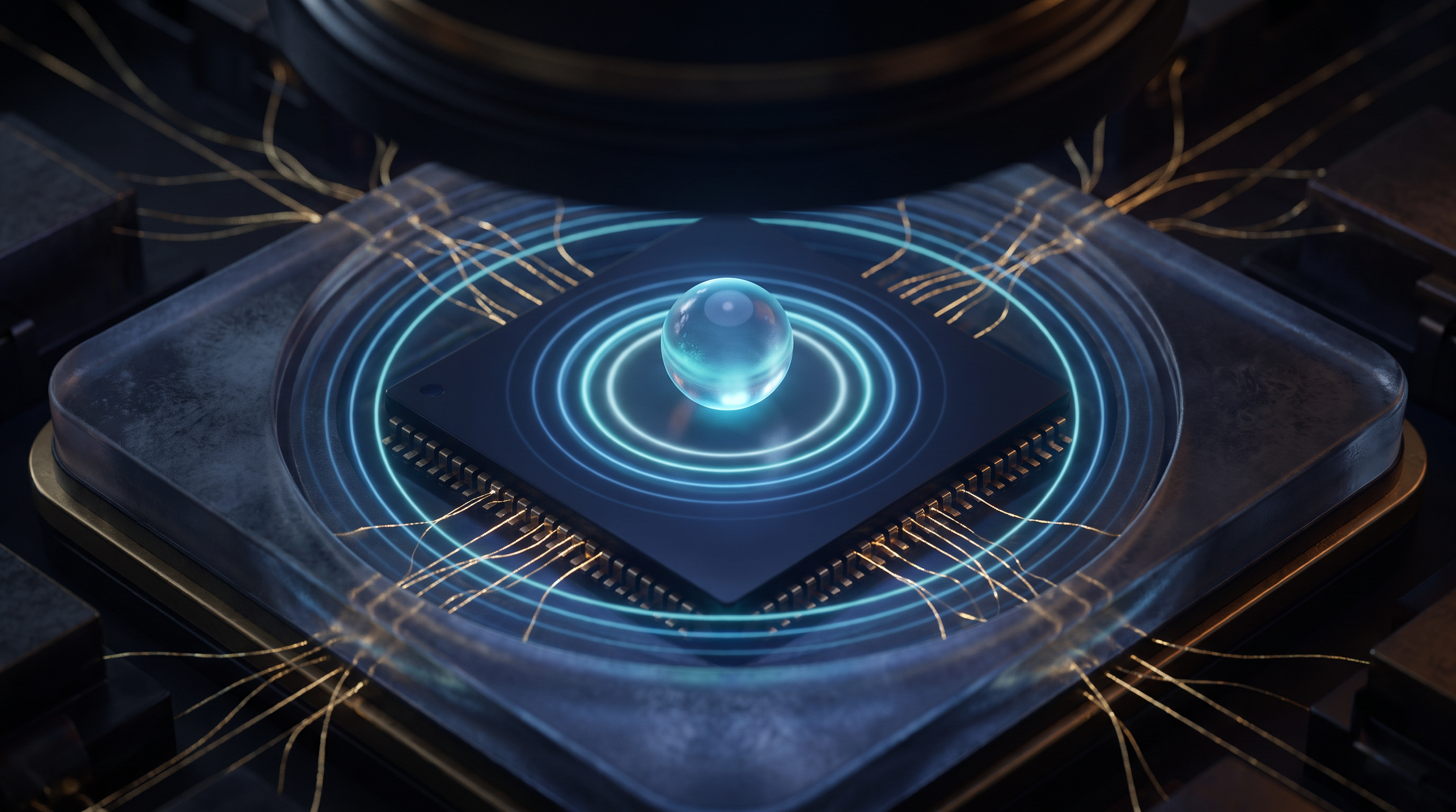
The first of four posts on two industries that will shape the next decade of computing, and why they’re quietly converging.
In my research on Quantum computing and photonics, I reviewed a variety of platforms and sources. When I opened the Quantum Economic Development Consortium's latest State of the Global Quantum Industry report, the number that caught me was not the market size, it was the cadence. Quantum computing revenue reached roughly $1.4 billion in 2025, up about 30 percent year over year, inside a broader quantum technology market of $1.9 billion. For an industry that spent thirty years as a physics experiment, that is real money moving at real speed.
Then there is what Google did. In December 2024 it unveiled Willow, a 105 qubit processor that, by Google's benchmark, solved a sampling problem in under five minutes that Google says would take the fastest classical supercomputers on the order of ten to the twenty fifth years (that's a lot of zeroes). In October 2025, Google published a follow up in Nature (science journal), what it calls the first verifiable quantum advantage demonstrated on hardware, running an algorithm it calls Quantum Echoes about 13,000 times faster than classical supercomputers, on a task that, unlike a contrived benchmark, maps onto real physical systems.
This post is the shortest, honest version of what a quantum computer is, why it matters now, and where the industry actually stands in 2026. Subsequent weekly posts will cover photonics, the place where the quantum computers and photonics intersect and then, lastly, the scope of Israel's Quantum and Photonics industries.
Why Quantum now?
Classical computers are not running out of road for most things. But there is a short list of problems where the structure of the calculation defeats a classical machine. Simulating molecules and materials. Certain optimization problems. And factoring the large numbers that underpin most public key cryptography. For these challenges, the market is not waiting for a faster chip, they're waiting for a different machine.
What changed is that the quantum hardware stopped being the joke. Willow did something the field had chased for decades. It showed that as you add more physical qubits to build a logical, error corrected qubit, the error rate goes down instead of up. That is the threshold below which error correction works in your favor rather than against you. The physics finally cooperates with the engineering.
I think of this as the qubit's transistor moment. The transistor did not change the world the day Bell Labs demonstrated it in 1947. It changed the world when it became reliable, cheap and manufacturable at scale. Quantum is at the point where the physics is proven and the remaining fight is now engineering.
The principles, without the math
A classical bit is a zero or a one. A qubit can be a zero, a one, or, while unmeasured, a weighted combination of both. That is superposition, the first component of quantum computing. Think of a coin spinning on the table. While it spins it is not heads or tails, it is a blur of both, and only when it lands does it pick a side.
The second component is entanglement. Two qubits can be linked so the state of one is bound to the other, no matter the distance. Measure one and it reads heads, the other reads heads too, instantly. This is the part that made Einstein nervous, he called it spooky action at a distance, and it is the resource that makes quantum computers powerful.
The third is interference. A quantum algorithm choreographs the qubits so wrong answers cancel and right answers reinforce. You are not checking every possibility one at a time, the cartoon version. You are arranging the waves so the answer you want survives measurement.
The reason people care about quantum computing is that, with a handful of algorithms and enough good qubits, quantum computers would do things classical machines probably cannot. Shor's algorithm factors large numbers, which is why security agencies care about the day a large quantum computer could break RSA. Grover's algorithm gives a square root speedup on search. And the near-term workhorses are variational methods, VQE and QAOA, which are hybrid. When a classical computer and a quantum processor work together, the quantum machine evaluates candidates and the classical machine tunes the search. These are the computers that companies actually run today on chemistry, materials and optimization.
The hardware zoo
There is no single winning qubit. There are at least five live approaches, and each is a bet on which trade off wins at scale. Superconducting qubits, the IBM and Google camp, are fast and borrow chip fabrication from semiconductors, but they need dilution refrigerators colder than deep space and they are noisy. Trapped ion machines, IonQ and Quantinuum, use individual ions in electromagnetic traps, with long coherence and high fidelity, but slower. Neutral atom systems, QuEra and Atom Computing, pack thousands of atoms into optical tweezers. Photonic qubits run on light, can in principle work at room temperature and use telecom fiber, with their own scaling problems I cover in part three. Topological qubits, which Microsoft has chased for years, promise built in error protection.
Every modality is good at the thing the next is bad at. Coherence versus speed, fidelity versus scale, connectivity versus control. Nobody has won because the problem is not picking the best qubit, it is building a million of them that stay correct long enough to be useful.
The 2026 reality check
We are still in what researchers call the NISQ era, noisy intermediate scale quantum. The machines are real, they are on the cloud, and they are not yet fault tolerant at a scale that changes industry. IBM, Google, IonQ, Quantinuum and Rigetti all offer cloud access through IBM Quantum and AWS Braket. You can, today, write a program and run it on a real quantum processor. Hundreds of enterprises are experimenting with these environments as you read this.
The fault tolerance frontier is where the serious money is aimed. IBM has committed to Starling, a large scale fault tolerant machine it says it will deliver by 2029, targeting 200 logical qubits running 100 million gates. Google's October 2025 result is the first verifiable quantum advantage on actual hardware, on a task that maps onto real physical systems rather than a contrived benchmark. That is the line between lab demo and tool.
The Israeli angle
Israel is not going to build a million qubit processor. The play is the control and software stack that every one of these machines needs regardless of modality, and that is where the country is genuinely strong. Quantum Machines, founded in Tel Aviv in 2018, raised $170 million and builds the control electronics that run a large share of the world's quantum labs. Classiq, the quantum software compilation company, raised $110 million in a Series C and is rumored to be part of a de-SPAC transaction in the second half of 2026. Together they were tapped by the Israel Innovation Authority to stand up the national quantum computing center. CTech counted close to $500 million flowing into five Israeli quantum companies in 2025 alone. DustPhotonics was recently acquired by Credo for an estimated $1.3 billion and Teramount was recently purchased by Molex for $430 million.
The quantum stack looks a lot like the classical one before it. The value did not all accrue to whoever made the fastest chip. It accrued to the companies that built the compilers, the control systems and the operating layers. Israel knows that layer. The qubit's transistor moment, if it comes, will not be won only by the people who make the qubit.
Final Thoughts:
Quantum in 2026 is a real industry with real revenue, real cloud access and one result, Google's Willow, that looks like the first crack between physics demonstration and useful machine. It is not ready to break your encryption and will not be for a while. The work to watch is error correction at scale, the control and software stack and the quiet engineering of getting from a handful of logical qubits to thousands. The qubit is having its transistor moment. The physics is done arguing. Now it is just engineering.
