
Light is the new Copper
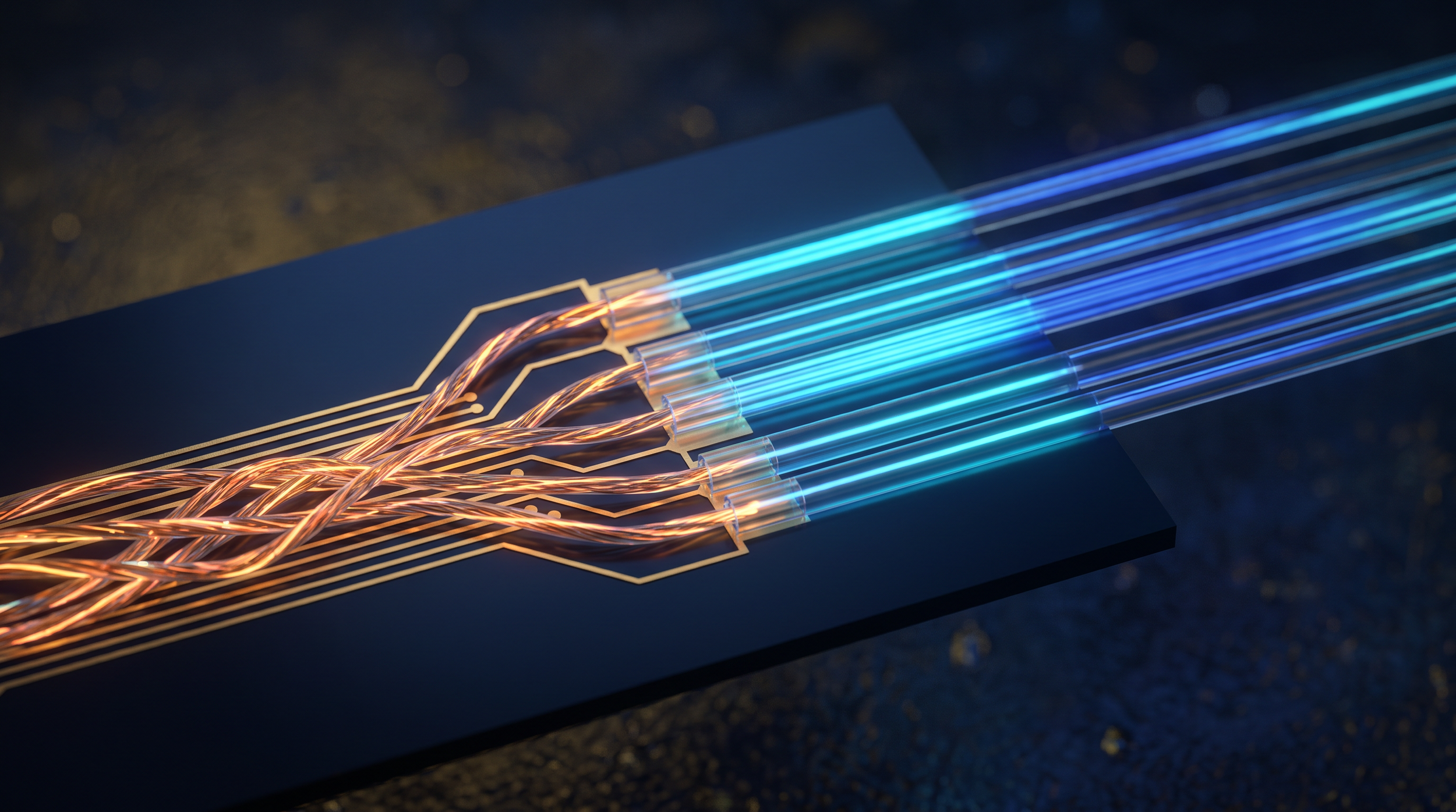
Photonics is already a trillion dollar industry holding up the AI boom. Quantum will borrow its supply chain.
The easiest way to understand photonics is to look inside an AI data center rack. The expensive part is not the servers (although they are pricey), it is the spaghetti of fiber optic cables connecting them, and the transceivers at each end that turn electrical signals into light and back again. Those little metal plugs cost more per port than the silicon they connect to. That is the photonics industry in one image.
According to multiple sources, the global photonics market crossed roughly one trillion dollars in 2025. MarketsandMarkets Consulting says the industry is around $1,094 billion, Fortune Business Insights posits $1,049.5 billion and Grand View Research comes in just under at $980 billion for 2024. By the SPIE count, core optics and photonics components alone reached $381 billion in 2024, underpinning a much larger market of products enabled by photonics. Lasers held about 38 percent of the market in 2025, by Mordor Intelligence count.
So the photonics business is a mature, trillion dollar industry, and most people have never heard of it.
What it is
Photonics is the generation, control and detection of light, photons, as opposed to the electrons that electronics move around. Light is fast and loses almost nothing over distance compared to copper, and for many jobs it uses a fraction of the energy. Where electronics hand you heat and resistance, photonics hands you bandwidth and efficiency. The same fiber that carries your internet under the ocean is, at smaller scale, the technology now being asked to carry data between the chips inside an AI server.
The building blocks have been around for decades. Lasers and LEDs to generate light. Photodetectors to catch it. Waveguides, tiny pipes for light on a chip, to route it. Modulators encode data onto the light. And the piece that ties it together, the photonic integrated circuit, or PIC, which does for light what the integrated circuit did for electrons. When that silicon is a standard wafer, you get silicon photonics, where the industry growth is now concentrated.
Why it is booming now
The answer is AI. Large language models are trained across tens of thousands of GPUs, and the bottleneck is no longer the compute, it is the connection between the compute. Copper interconnects are hitting a power and distance wall. An 800G optical transceiver draws roughly 16 to 17 watts, and the industry is already pushing past it to 1.6T transceivers entering production in 2025 for Nvidia and the hyperscalers.
The inflection came at Nvidia GTC in March 2025, when Jensen Huang unveiled Nvidia new silicon photonics networking switches, built to let AI factories connect millions of GPUs across sites while cutting power. That was the moment copackaged optics, moving the photonic engine right up against the switch chip, went from a research promise to a shipping product category.
This is why I call light the new copper. For seventy years computing was built on moving electrons through copper. The next seventy will be built on moving photons through silicon, diamond and fiber. The copper does not disappear, any more than the horse disappeared the day the car arrived. But the growth, the margin and the strategic value migrate to light.
Photonics is bigger than AI, of course. The same lasers, detectors and modulators run the telecom networks that carry the world internet, the LiDAR sensors that let autonomous vehicles see, the industrial lasers that cut and weld metal, the medical imaging and surgical systems in hospitals and the displays you are reading this on. AI is the accelerant right now. The breadth is why it is already a trillion dollar market.
The market and the fastest corner
The overall market grows at a modest 4 to 7 percent a year, because it has a big mature base that includes displays, lighting and legacy telecom. The interesting part is silicon photonics and PICs, which are small but growing fastest. MarketsandMarkets sizes silicon photonics at $2.16 billion in 2024 on its way to $9.65 billion by 2030, a compound annual growth rate near 30 percent. Mordor Intelligence has it at $2.83 billion in 2025 climbing to $13.18 billion by 2031. Transceivers alone held 62 percent of that market in 2025, by Astute Analytica estimate. The pattern is the same in every source: a slow growing trillion dollar ocean, with a fast growing river of silicon photonics feeding into it.
The supply chain, and where Israel sits
What makes photonics powerful, and what will matter in part three, is that it is built on a foundry and packaging supply chain that looks increasingly like semiconductors. The same 300 millimeter wafer fabs, the same packaging and heterogeneous integration, the same move from hand assembly to mass manufacturing. That is what makes it cheap and scalable.
Israel sits in this stack in a characteristically Israeli way, not at the commodity end but at the high value instrumentation and specialty end. Nova and Camtek, both traded on the Tel Aviv Stock Exchange under NVMI and CAMT, build the metrology and inspection equipment that the semiconductor industry uses to measure what it makes, the same inspection stack that silicon photonics now runs through. Lumenis, the medical laser company founded in Israel, was for years the name in surgical energy. Elbit Systems and Rafael both run serious optics and sensing businesses inside their defense portfolios. Intel large Israel development centers, in Haifa and Petah Tikva, sit deep in the semiconductor engineering layer that photonics increasingly borrows from. Tower Semiconductor in Migdal HaEmek is the piece most people miss. It is one of the few foundries on earth with a mature silicon photonics process, and it is expanding that capacity for copackaged optics as AI racks swallow more light. Israel is not the volume producer of photonics. It sells the picks and shovels, and the specialty optics, to the people who are.
The last twelve months made that more concrete than any market slide. In April 2026 Credo agreed to buy Modiin based DustPhotonics for $750 million in cash plus stock, with milestones that could take the deal to $1.3 billion. DustPhotonics, founded in 2017 by Kobi Hasharoni, Amir Garon and Ben Rubovitch and chaired by Avigdor Willenz, built silicon photonic chips for 800G and 1.6T interconnects. Intel Capital, Greenfield Partners and Willenz sat on the cap table. The same week Molex agreed to buy Jerusalem based Teramount for about $430 million. Teramount, founded by Hesham Taha and Avi Israel out of the Hebrew University, solved the ugly problem DustPhotonics did not: how you actually attach fiber to a photonic chip at volume, with a passive, detachable coupler instead of expensive active alignment. Grove Ventures and Koch Disruptive Technologies led the last private round, with AMD, Hitachi, Samsung and Wistron as strategics. Two exits in the same week is not a coincidence. It is the market pointing at the same bottleneck.
What is left on the field looks a lot like those two companies. NewPhotonics in Petach Tikva is the closest remaining peer. Founded in 2020, it designs photonic integrated circuits for linear pluggable optics and copackaged optics, with on chip optical signal processing meant to cut power and latency in AI clusters. PitchBook has it at more than $50 million raised. ColorChip in Yokneam is the older cousin. Founded in 2001, it has raised about $97 million and still sells photonic ICs and high speed single mode transceivers into the same data center stack on its SystemOnGlass platform. PacketLight Networks in Tel Aviv sits one layer up, shipping WDM and OTN boxes rather than chips, with about $29 million of equity behind it. Different product, same fiber.
Then there is the compute side of the same physics. CogniFiber in Tel Aviv is putting neural networks inside multi core optical fiber and claiming inference at a fraction of GPU energy. It is at Series A with about $14 million raised. LightSolver, a Weizmann spin out, is building laser processing units for combinatorial problems that electronic machines chew on slowly. Quantum Source in Rehovot is a different bet entirely, photonic qubits rather than data center ports, but it is using the same photonics talent and the same packaging headaches, and its Series A sits at about $77 million. Prisma Photonics watches the fiber instead of transmitting on it, distributed sensing on existing optical networks, Series D and about $80 million. CyberRidge encrypts the light in the cable itself and came out of stealth with $26 million.
Our view: the Israeli story in photonics is not a foundry story and it is not a volume transceiver story. It is a specialty interconnect and instrumentation story that just got priced by two strategic buyers. DustPhotonics and Teramount were the proof that hyperscalers will pay real money for the last meter of light. NewPhotonics and ColorChip are still independent in that same meter. CogniFiber and LightSolver are what happens when the same physicists decide the light should compute, not just carry. Tower makes the wafers. Nova and Camtek measure them. That is a stack, not a slogan.
Last Thoughts:
Photonics is the rare foundational technology that is already huge and still accelerating. The reason it is accelerating is AI, and the reason AI needs it is that copper ran out of headroom. The trillion dollar market you have never thought about is the one holding up the AI boom, on a manufacturing base that looks more like semiconductors every year. Hold that thought. The same foundries, the same packaging and the same fiber that carry your AI traffic are exactly the infrastructure the quantum industry is about to try to ride. Light is the new copper. In Israel the interesting companies are the ones selling the coupler, the PIC and the inspection tool, not the cable itself.
